
Comfort Zone
Written & directed by Joshua Timpko
Logline:
A tight-knit group of Brooklynites discovers one of their own hasn't left his apartment in four months. Getting him out turns out to be the least of their problems.
Mission statement:
Comfort Zone isn't a film about mental illness. It's about the people on the outside of it — friends who are struggling in their own ways, too busy or too broken to notice someone slipping away. The story of how we fail each other often, and what it costs.
The STory

Let's be honest, we are living through a paradox. Millennials and Gen Z are, by virtually every measure, the most mentally health-literate generations in history. We/they have the vocabulary — attachment styles, intrusive thoughts, nervous system dysregulation — the therapy memes, the destigmatization campaigns, and the genuine, hard-won cultural shift that made it acceptable, even expected, to talk openly about struggling. And yet, rates of anxiety, depression, and loneliness among young adults have never been higher. Knowing the language, it turns out, is not the same as knowing what to do.
Comfort Zone lives inside that gap.
The film is set in Brooklyn among a group of friends in their mid-to-late twenties — a generation that came of age during the 2008 financial crisis, graduated into economic precarity, survived a global pandemic, and inherited a world that offers them unprecedented access to community and an unprecedented capacity for isolation.
For this generation, friendship has taken on an outsized weight. As traditional support structures — religion, geographic community, stable family units — have weakened, the friend group has become the primary unit of emotional life. These are the people you call at 2am. These are the people responsible for knowing when something is wrong.
But what happens when something is wrong and you don't know how to fix it? What happens when the person you love doesn't want to be fixed?
Comfort Zone approaches the mental health crisis not from the perspective of the person suffering, but from the perspective of the people around them — the friends who notice, who worry, who argue about what to do and ultimately have to make peace with the limits of what love can accomplish. In doing so, it taps into a conversation that is everywhere and yet rarely explored honestly on screen: the emotional labor of being someone who pays attention, the guilt of not doing enough, and the complicated ethics of intervening in someone else's inner life.
At the same time, the film engages with the specific cultural texture of this generation — the dark humor, the self-awareness, the simultaneous embrace of emotional openness and deep discomfort with vulnerability. These are people who know all the right things to say and still manage to say the wrong thing. Who believe in therapy in theory and struggle to suggest it in practice. Who love each other fiercely and imperfectly and without a roadmap.
Comfort Zone is a film about that experience — not as a crisis to be solved, but as a condition to be lived in. It asks what community looks like when the old structures are gone, what responsibility looks like when everyone is struggling, and what it means to show up for someone when showing up is the only thing you actually have to offer.
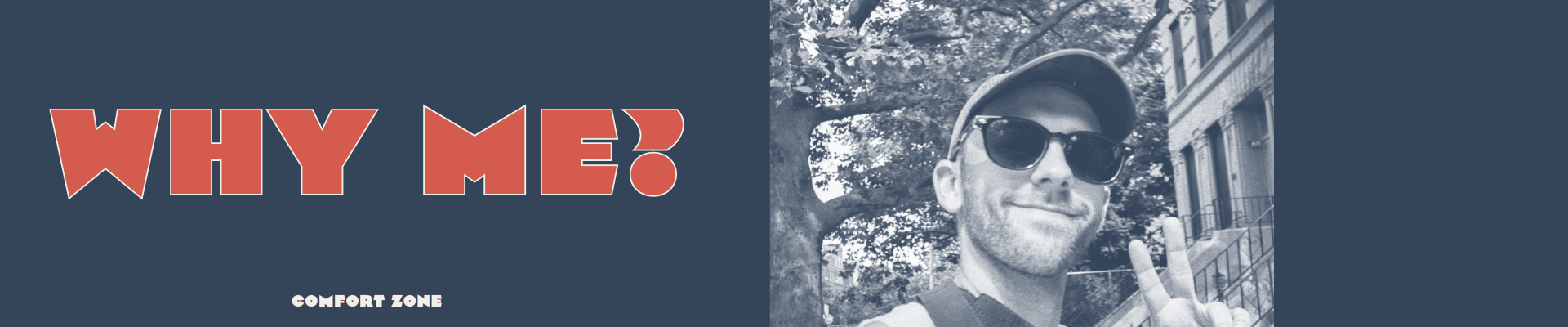
Comfort Zone began as an act of self-examination. When I turned 25, anxiety arrived in my life without warning and without precedent — suddenly, leaving my apartment became difficult to bear. I found myself canceling plans, constructing excuses, wearing the same mask I'd always worn while my nervous system staged a revolt. Jeremy's story is, in no small part, my own.
The film's inciting incident — Jeremy running home in a panic, convinced he left the stove on — is drawn directly from my experience. So is the deeper architecture of his condition: the performance of normalcy, the gap between how he presents to the world and what is actually happening inside him, the exhausting work of seeming fine. I wrote the script in part as a way of processing that experience, and in part as an act of imagination — turning the camera around, stepping outside myself, and asking the question I had never been able to answer: what would my friends do if they found out?
That question forced me to reckon with something uncomfortable. How equipped were the people I loved to handle a crisis like this? And by extension, how equipped was I to handle it if the situation were reversed? I didn't know. I still don't, entirely. That uncertainty is the engine of this film.

The $33,000 we're raising here represents the heart of what it means to make this film the right way. $28,000 goes directly to paying our cast and crew — because the people giving their time and talent to this story deserve to be compensated fairly, full stop. The remaining $5,000 covers meals across our 11-day shoot in Brooklyn. These aren't line items we're willing to cut.
We can shoot with natural light. We can work without the expensive gear. We can find creative solutions to almost every production problem a microbudget throws at you. What we CAN'T do is make this film without a passionate, committed crew — and passion doesn't survive long when people feel like their work isn't being taken seriously. In an economy that's already asking so much of working artists, the least we can do is make sure no one walks off this set feeling like their time didn't matter. A paid crew is a present crew. A present crew makes a better film. And a better film is what we owe this story.
This campaign gets us through production. We're shooting in September, and every dollar raised here moves us from "we're making this" to "we made this." Post-production is already being planned in parallel — picture lock, sound, color — with a festival submission target to follow.